
Financial adviser requirements in Ireland: 2026 checklist
Who has to be authorised, which qualification counts for which products, what the Central Bank register shows and what the firm's own file has to prove every year. A plain Irish map, with a checklist at the end.
 James Brooks · Founder, Kaitel · 7 min read
Financial adviser requirements in Ireland begin with a firm authorised by the Central Bank. Each adviser needs a recognised qualification, grandfathered status or new-entrant supervision for the products they advise on, and the firm certifies them as fit and proper every year. The register is searched by firm, so the firm's file has to prove the rest.
Many searches say 'financial advisor'. The Central Bank and this post say 'adviser'.
What's covered
- Authorisation belongs to the firm, and it is an offence to intermediate without it.
- The Qualified Financial Adviser (QFA) qualification is one recognised qualification among several, and the right one depends on the product category the adviser covers.
- An adviser giving advice holds a controlled function (CF-3), and the firm certifies them as fit and proper every year.
- The Central Bank register is searched by firm, so an adviser's qualification, CPD and certification are proved by the firm's own file.
- The yearly file is short: certification, 15 hours of CPD, an annual review and records kept after the adviser leaves.
Financial adviser requirements in Ireland start with the firm's authorisation
Authorisation is the firm's, not the adviser's. The Central Bank lists four authorisation routes, and the one that applies depends on what the firm does:
- Insurance Distribution Regulations 2018: insurance and reinsurance intermediaries.
- Investment Intermediaries Act 1995: investment business, including advising on investment products.
- Consumer Mortgage Credit Agreements Regulations 2016: mortgage credit intermediaries.
- Consumer Credit Act 1995: mortgage intermediaries.
The Central Bank puts the stakes plainly. It is an offence to engage in insurance, investment or mortgage intermediation without authorisation or registration.
Applicants also complete an online Individual Questionnaire to comply with fitness and probity requirements.
We counted the firms on the Central Bank's advice registers on 23 October 2026. About 48% of them sit on more than one register.
So a firm can need more than one authorisation. Our data does not show why a given firm is on several.
The QFA is one recognised qualification, not the legal minimum for every adviser
What is the best qualification for a financial adviser in Ireland? It depends on the product category. The QFA is the recognised one for five of the eight categories.
“The qualifications and/or experience required depends on the retail financial products you intend to provide to consumers.” Central Bank of Ireland, Investment Brokers / Intermediaries page
Some pages that rank for this search call the QFA the minimum legal qualification. The Central Bank's own table says otherwise.
The QFA is listed for:
- life assurance
- pensions
- savings and investments
- housing loans, home reversion agreements and associated insurances
- consumer credit and associated insurances
It is not listed for personal general insurance, commercial general insurance or private medical insurance. Those three list the Certified Insurance Practitioner, Associate or Fellow of the Chartered Insurance Institute, and an Accredited Product Adviser award.
There is also a route for people without a qualification yet. The Minimum Competency Regulations 2017 allow a 'new entrant' to act in a controlled function without a recognised qualification, under the conditions the Code sets. 'Grandfathered person' is a separate status under the Code.
So the test is a recognised qualification for the product category, or grandfathered status. It is never 'only the QFA'.
Every adviser holds a controlled function, and the firm certifies them as fit and proper each year
Under fitness and probity, the adviser's role is a controlled function. In the Central Bank's CF and PCF lists, CF-3 is giving advice to a customer.
An employed adviser giving advice is a CF-3 holder. Arranging a financial service for a customer is CF-4.
For a small practice there is a second layer. The PCF list also names sole traders, partners and executive directors, so an owner-adviser can appear on it as well.
The duty to certify sits with the firm. It must make sure each holder meets the standards before appointment and on an ongoing basis, and then it certifies them.
The annual submission goes through the Central Bank Portal for each active CF and PCF holder.
The Central Bank published its consolidated fitness and probity guidance on 25 November 2025. Our fitness and probity guide for small practices covers the detail.
The Central Bank register is searched by firm, so the adviser's file has to prove the rest
It is easy to read 'authorised' as describing a person. The register is the Financial Service Provider Search, a search by firm name, filtered by type.
The search asks for a firm's name, with filters for type and sub-type. It has no box for an adviser's name.
The Central Bank also publishes PDF registers with 'as at' dates, such as the Insurance Distribution Register as at 6 November 2026.
In the register data we hold from 23 October 2026, no field names an individual adviser or holds a qualification, CPD record or fitness and probity certification. So each requirement is proved somewhere different:
Requirement | Shown on the register? | Where it is proved |
|---|---|---|
Firm authorisation | Yes, by firm name and type | The Central Bank register |
Adviser's recognised qualification | Not in the data we hold | The firm's register of accredited persons |
CF-3 or CF-4 certification | Not in the data we hold | The firm's annual certification records |
CPD hours | Not in the data we hold | The firm's CPD records |
Take an invented practice in Wexford. Aoife is about to meet an adviser, Colm, for the first time, so she searches the register for his name. She finds the firm, authorised and listed, but nothing under Colm's name, and she wonders if he is qualified.
The practice owner, Niamh, answers from the file. She sends the date of Colm's recognised qualification, his CF-3 certification for this year and his CPD log. Those records are the firm's to keep.
The register told Aoife the firm is authorised. The firm's file told her the adviser is qualified.
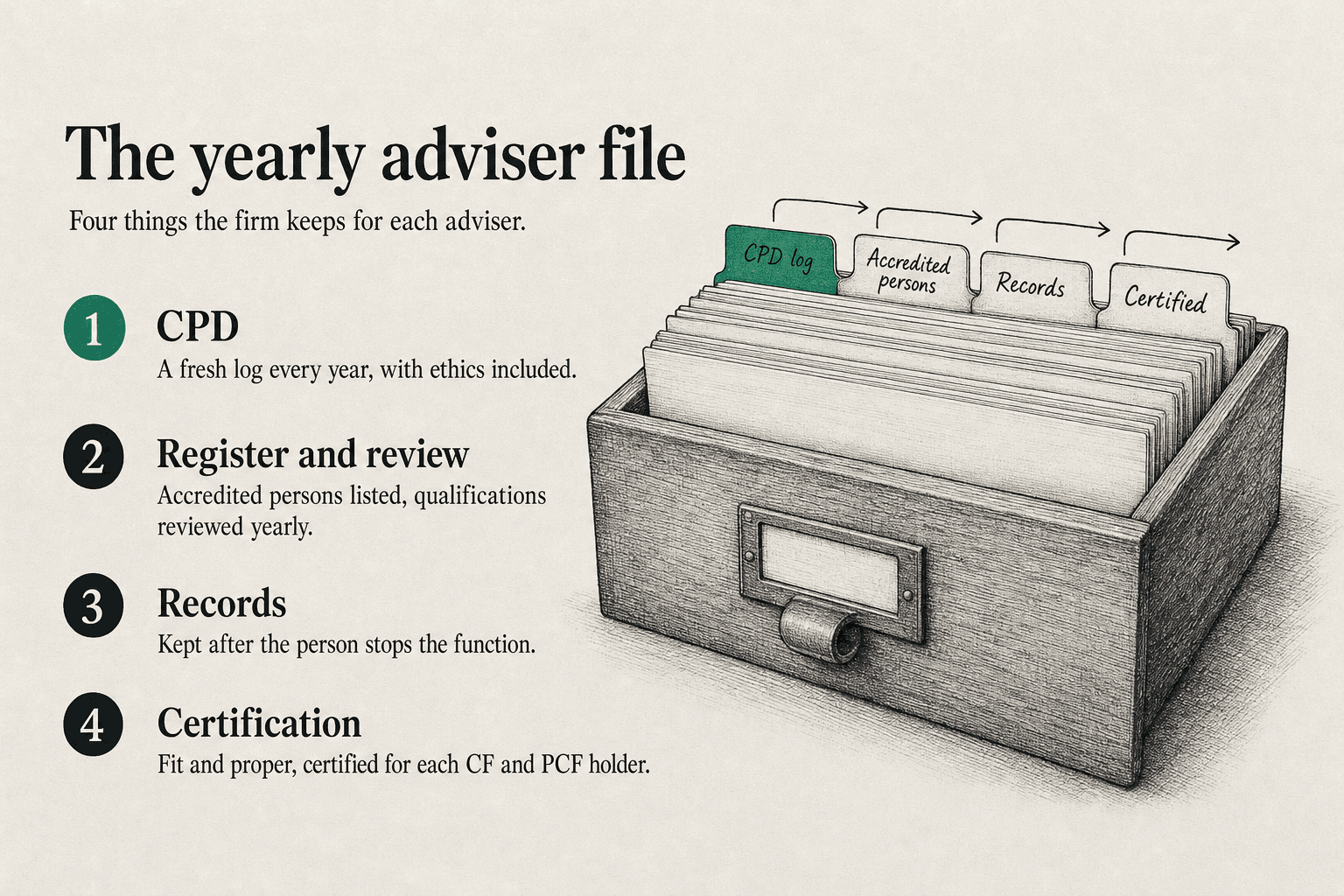
Financial adviser requirements in Ireland continue every year, and the firm's file has to show them
The yearly file has four parts for each adviser, plus a few duties that belong to the firm.
CPD. Under the Code's CPD standard, each adviser needs 15 hours of CPD a year, so each needs a fresh log every year.
At least one hour must be on ethics, and surplus hours do not carry over.
Register and review. The firm keeps a register of accredited persons, including the date the person obtained a recognised qualification or was grandfathered.
It also carries out an annual internal review of qualifications and of development and experience needs.
S.I. 295/2026 changed the annual review wording from 28 July 2026, and the 'consumer' test for incorporated bodies too. Our Minimum Competency Code guide has the detail.
Records. Under the Minimum Competency Regulations 2017 and the Code, the firm keeps the records for at least six years after the person stops performing the function. For grandfathered persons, certain duties continue after those six years. Our post on Minimum Competency Code duties and records lists them.
Certification. The firm certifies each CF and PCF holder as fit and proper every year, as set out above.
The firm also has duties of its own, separate from any one adviser:
- professional indemnity insurance, named for each authorised activity, with cover ring-fenced for each where the policy has an aggregate limit
- the annual online return
- the annual industry funding levy
- telling the Central Bank about changes that affect the authorisation
A complete adviser file passes these checks
Before an adviser is taken on or signed off, check:
- The firm is authorised under the route that matches what it does, and shows up on the Central Bank register by name and type.
- The adviser's recognised qualification (or grandfathered status) matches each product category they will advise on.
- Their role is recorded as CF-3 or CF-4, and an owner-adviser's PCF role is recorded too.
- This year's fitness and probity certification is done through the Central Bank Portal.
- Their 15 hours of CPD are logged, including at least one on ethics, with nothing carried over.
- The register of accredited persons and the annual review are up to date.
- Records will be kept for six years after they stop the function.
- Professional indemnity insurance names each authorised activity, and the annual return and levy are done.
Keep it in one place
A firm that can show, for each adviser, the qualification, the certification and the CPD in one place can answer a client or the Central Bank in one sentence.
We've been building Kaitel with a small group of Irish practices, ahead of a private launch. You can join the waitlist and we'll keep you posted.
Sources
- Central Bank of Ireland, Qualifications (Appendix 4 of the Minimum Competency Code, Parts 1 to 3), undated page, read 7 November 2026
- Central Bank of Ireland, Brokers / Retail Intermediaries, undated page, read 7 November 2026
- Central Bank of Ireland, Investment Brokers / Intermediaries, undated page, read 7 November 2026
- Central Bank of Ireland, Guidance on the Standards of Fitness and Probity: Appendix (CF and PCF lists), 25 November 2025
- Central Bank of Ireland, Ongoing Compliance for Regulated Financial Service Providers, undated page, read 7 November 2026
- Central Bank of Ireland, Minimum Competency Code 2017, undated document, read 7 November 2026
- Central Bank of Ireland, Minimum Competency Code 2017 and Minimum Competency Regulations 2017: Questions and Answers, June 2026
- Irish Statute Book, S.I. No. 391/2017 Minimum Competency Regulations 2017, 1 September 2017
- Irish Statute Book, S.I. No. 295/2026 Minimum Competency (Amendment) Regulations 2026, 25 June 2026
- Central Bank of Ireland, Guidance for Retail Intermediaries on the Requirement to hold Professional Indemnity Insurance Cover, October 2024
- Central Bank of Ireland (Registers), Financial Service Provider Search, undated page, read 7 November 2026
- Central Bank of Ireland (Registers), Registers: Downloads, 6 November 2026
- Kaitel, count of the Central Bank advice registers (registers.centralbank.ie), 23 October 2026
The meeting ends. Kaitel gets to work.
Early access · 15 Irish practices in January

James Brooks is the founder of Kaitel. An investment analyst turned founder, he works directly with practising Irish advice firms on the paperwork around the client meeting: fact finds, file notes, suitability letters and follow-ups.