
Consumer Protection Code 2025: checklist for Irish advisers
The Consumer Protection Code 2025 has been in force since March 2026. We took the regulations an Irish advice practice meets in a normal week and turned each into a plain question: what do we record, what do we tell the client, and who is responsible.
 James Brooks · Founder, Kaitel · 9 min read
The Consumer Protection Code 2025 was made on 24 March 2025 (Irish Statute Book, 24 March 2025) and has been in force since 24 March 2026 (Central Bank of Ireland, undated page). It replaced the 2012 Code (Central Bank of Ireland, S.I. 81 of 2025, in force 24 March 2026). For an advice practice, each rule comes down to what is recorded, what the client is told and who is responsible. Which rules apply depends on the practice's authorisations.
We counted the Central Bank register in September 2026 and found 2,616 firms. Of those, 2,615 carry at least one retail intermediary line and 2,557 are small practices, meaning three or fewer named responsible people (Kaitel count of the Central Bank register, as at 29 September 2026). An authorisation is not activity, "small practice" is a proxy and not headcount, and the count doesn't tell us how many of these firms fall inside the Regulations. So below, each rule a practice meets in a normal week becomes a plain question.
What the Consumer Protection Code 2025 changed, and the dates to hold on to
S.I. No. 81 of 2025 came into operation on 24 March 2026, after a 12-month implementation period (Central Bank of Ireland, undated page). Reg 1(2) says it in one line: "These Regulations come into operation on 24 March 2026" (Irish Statute Book, 24 March 2025). A further amendment, S.I. No. 111 of 2026, took effect on 25 March 2026, and the Central Bank calls it "a limited number of clarifications and corrections" (Central Bank of Ireland, S.I. 81 of 2025, in force 24 March 2026).
The General Guidance was first published in March 2025 (Central Bank of Ireland, undated page) and last updated in September 2026 (Central Bank of Ireland, September 2026). The Standards for Business Regulations sit alongside the Consumer Protection Regulations, and this post covers the second set (Central Bank of Ireland FAQ, undated page).
Look, a good deal of it will feel familiar. A&L Goodbody lists suitability, conflicts, commission and remuneration, record keeping, errors and complaints handling as "enhanced", and digitalisation, securing customers' interests and vulnerable customers as "new" (A&L Goodbody, March 2025). That is the law firm's classification, not the Central Bank's.
Does the Consumer Protection Code 2025 apply to your practice? Start with your authorisations
The Regulations apply to Investment Business Firms and Investment Intermediaries authorised under the Investment Intermediaries Act 1995, to Insurance Intermediaries and to Mortgage Intermediaries (General Guidance 1.2.5, Central Bank of Ireland, September 2026). MiFID services are outside them, other than services of a person excluded from MiFID by Regulation 4(3) of the 2017 MiFID Regulations (1.2.6, same source). Reg 15 is headed "Circumstances in which these Regulations do not apply" (Irish Statute Book, 24 March 2025). Credit intermediaries authorised by the CCPC are outside the Code (Central Bank of Ireland FAQ, undated page).
Say you're three advisers in Galway, an invented practice, holding an insurance intermediary authorisation and an investment one under the 1995 Act. Both are on the list, but any MiFID services you provide are a separate matter. Your authorisation letter, not this post, settles which side each service falls on.
Then there is the word "consumer". It covers a natural person, and an incorporated body only if its turnover was not over €5 million in the previous financial year and it is not in a group with combined turnover above that (FAQ 5, same page as above). Reg 116 is one line: "A regulated entity shall identify in its records those customers that are consumers" (Irish Statute Book, 24 March 2025). We can't say how many firms on the register this reaches. So the question for your own practice is this: can our records show which clients are consumers?
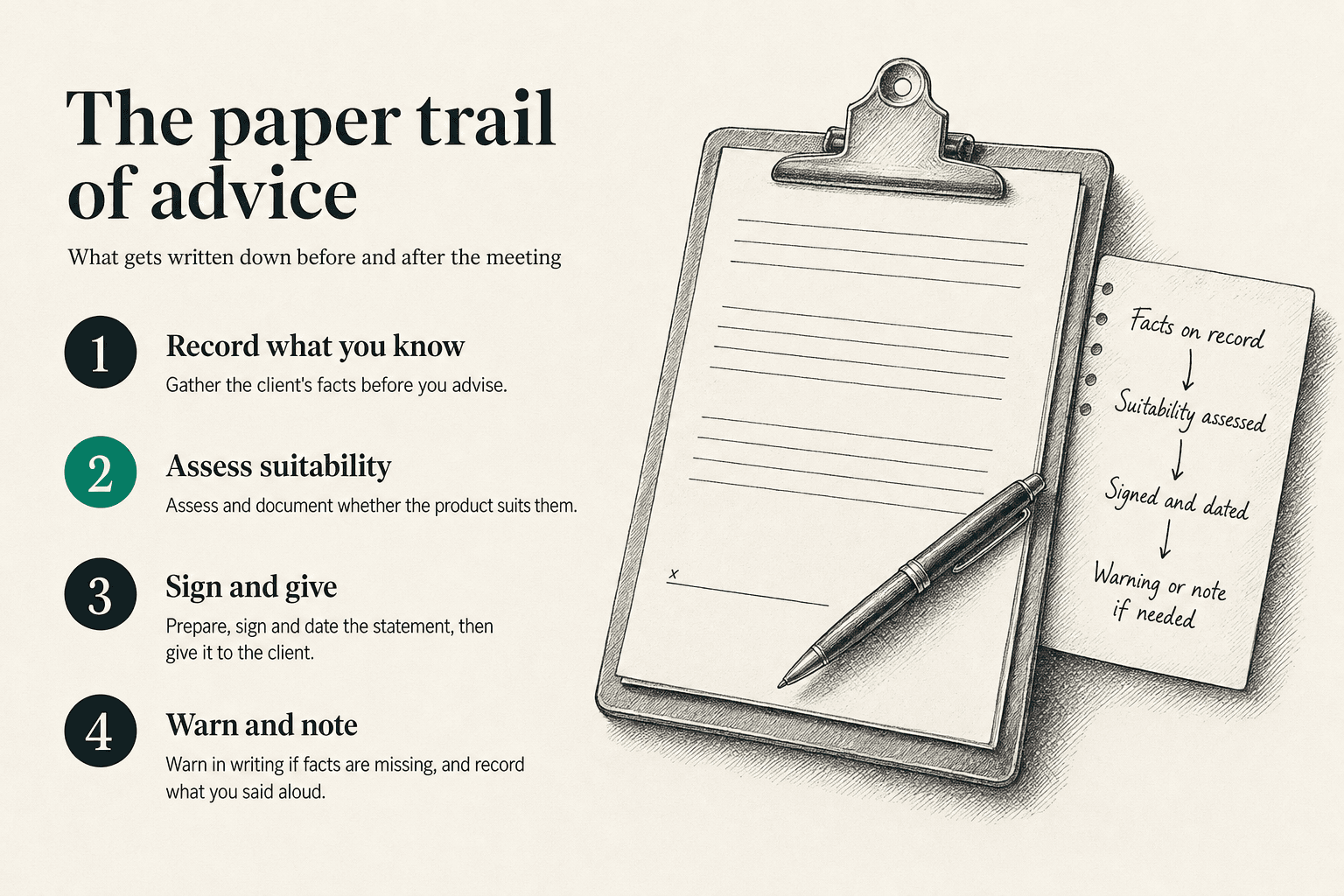
Knowing the client, suitability and the statement of suitability: what gets recorded after the meeting
Before the meeting, the Regulations ask what you know. Reg 16(1) says an entity "shall gather and keep a record of sufficient information from a consumer in accordance with this Regulation prior to offering, recommending, arranging or providing a financial service appropriate to that consumer" (Irish Statute Book, 24 March 2025). The list of information sits in the later paragraphs of that Regulation. Reg 17(1) requires an assessment of suitability, 17(2) begins "assess and document", and 17(5) says a recommended product "shall be the most suitable product for that consumer".
After the meeting, Reg 18(1) says the entity shall "prepare, sign and date a statement of suitability on paper or on another durable medium and shall provide it to the consumer". Where the information needed to judge suitability is missing, Reg 18(3) requires a written warning before an investment product is provided. Where you gave an oral explanation, the Regulations require "a record of this explanation in, or with, the statement of suitability" (the paragraph on oral explanations in Reg 18).
So three questions. What do we record before and after advising? What do we tell the client, and in what form? And who prepares and signs the statement?
What the client is told: remuneration, fees, terms of business and the words 'independent' and 'broker'
Reg 31(1) covers ongoing remuneration from a product producer. The intermediary "shall disclose to a consumer the basis on which the product producer is providing such remuneration to the intermediary and the nature of the service to be provided to the consumer in respect of this remuneration" (Irish Statute Book, 24 March 2025). Where the amount can't be ascertained, 31(3) requires the method of calculation to be disclosed. Reg 31(4) says it does not apply where the service relates to an insurance policy.
Reg 33(1) covers fees. Where an intermediary offers payment by fee, "the option of payment by fee and the amount of the fee shall be explained in advance to the consumer". Reg 33(2) opens with the case of a fee plus commission and requires the intermediary to "specifically explain" whether the commission is offset, and the rest of that paragraph is worth reading. Regs 30 and 32 are headed disclosure of fees and commissions by mortgage intermediaries and Investment Intermediaries Act firms, and the published summary of fees and commissions (Central Bank of Ireland, S.I. 81 of 2025, 24 March 2025).
Reg 51(1) requires terms of business on paper or a durable medium before the first service. Under 51(2), where an intermediary acts for another regulated entity, only the intermediary provides its terms. Reg 54(1) allows "independent" only "where all regulated activities provided by the intermediary are provided on the basis of a fair analysis of the market". Reg 56 is headed "Use of term 'broker' by intermediaries subject to conditions", so conditions apply, and the text sets them out.
The questions follow. What do we record that we told them? What do we say about commission and fees? And who checks our trading name and website wording?
Errors and complaints: who owns the log
Reg 99 requires "an up-to-date log of all errors identified which affect regulated activities provided to consumers" (Irish Statute Book, 24 March 2025). The items we saw are the details of each error, the date discovered, how it was discovered, the period it ran and the number of consumers affected. Reg 100 requires a record of the steps taken to resolve an error that affects consumers. The General Guidance says at 3.8.1 that "It is important that firms take ownership and responsibility for managing errors that affect consumers" (Central Bank of Ireland, September 2026).
Say you're four advisers in Sligo, another invented practice. In one month a policy start date is keyed wrong, a premium is entered twice and a letter goes to an old address. Each is fixed the same day. The Guidance asks "Whether a number of small errors, taken together, could be considered 'significant'" (3.8.1, same source). So did anyone add them up?
Complaints work the same way. Reg 106 says an entity "shall keep and maintain an up-to-date log of all complaints from consumers" (Central Bank of Ireland, S.I. 81 of 2025, 24 March 2025). Reg 107(1) requires governance arrangements for handling them. Under 107(3), the full procedure need not apply to a complaint resolved to the consumer's satisfaction within 5 working days, but the log must still be kept.
The Guidance at 3.9, which is the regulator's own view, asks for a "substance over form" approach and says price dissatisfaction is judged case by case. A complaint filed as a query is the risk. Who owns the log, and who reads it at month end?
What records does an adviser have to keep under the Consumer Protection Code 2025, and for how long?
Consumer transaction records are kept for 6 years from the end of the transaction. Records of an enquiry that went nowhere are kept for 12 months, with the consumer's consent. Each has conditions, set out in Reg 117 (Central Bank of Ireland, S.I. 81 of 2025, 24 March 2025).
Reg 117(1)(a), subject to paragraphs (2), (3) and (4), says an entity shall "retain any records which detail consumer transactions in respect of its regulated activities for 6 years after the date on which the particular transaction is discontinued or completed". Reg 117(2) covers a consumer who asked for or was offered a service but did not get it. The entity shall, subject to the consumer's consent, retain the record for 12 months. Reg 115 requires up-to-date records, and the list of what they include is worth reading in full.
For enquiries, General Guidance 3.10.1 says "The retention of such data for six years is not necessary or proportionate and there is now a requirement on firms to retain that data for a 12-month period" (Central Bank of Ireland, September 2026). The Guidance ties this to data protection. Under Reg 115(3), where a consumer does not consent to a record being kept, or withdraws consent, the entity "is not required by these Regulations to retain the record". The Reg 116 consumer flag matters here too.
So what do we keep, for how long, and who can say so without looking it up?
What the Central Bank has said it will look at now the Code is in force, and where vulnerable customers come in
The Central Bank published its Regulatory and Supervisory Outlook 2026 on 26 February 2026, according to William Fry (William Fry, 6 March 2026). William Fry read it for insurance intermediaries and wrote that for retail intermediaries the Central Bank "will continue its more indirect, thematic, and data-driven supervisory approach, using cross-sectoral reviews and targeted, risk-based interventions rather than routine direct engagement". On their reading, the Central Bank has said it will review commission arrangements across sectors, how customers in vulnerable circumstances are identified and treated (from Q3 2026 onwards) and unregulated services from retail intermediaries. We haven't read the Outlook itself, and we haven't confirmed these reviews cover investment and pension advice firms.
The FAQ defines a "consumer in vulnerable circumstances" as a natural person "whose personal circumstances, whether permanent or temporary, make that consumer especially susceptible to harm, particularly where a regulated entity is not acting with the appropriate levels of care" (Central Bank of Ireland FAQ, undated page). Reg 36 is headed "Trusted contact person", and a trusted contact person "has no authority to deal with the affairs of a personal consumer" (FAQ 7, same page). Footnote 5 of the General Guidance says the Central Bank does not expect MiFID firms to comply with the trusted contact person and training requirements (Central Bank of Ireland, September 2026).
Say a client of yours was widowed in the spring and now misses calls and asks you to repeat what you explained last time. The check is whether anyone in the practice would notice, and where it would be written down.
Which of these is hardest will differ from one practice to the next, and I'd say it is the one where nobody can name who owns the answer. Everything else on this list has a document behind it, and that one needs a name.
We have been building Kaitel with a small group of Irish advice practices, ahead of a private launch, to help with the work after a client meeting. A practice that wants to be kept posted can join the waitlist, and I reply personally to everyone who signs up.
The meeting ends. Kaitel gets to work.
Early access · 15 Irish practices in January

James Brooks is the founder of Kaitel. An investment analyst turned founder, he works directly with practising Irish advice firms on the paperwork around the client meeting: fact finds, file notes, suitability letters and follow-ups.