AI for financial advisers: Irish rules and supplier questions
No Irish rule names AI note-takers, so the record, data protection and outsourcing rules already in force do the work. Here is what they say, with dates, and the questions to put to any supplier before a tool touches a client file.
 James Brooks · Founder, Kaitel · 7 min read
AI for financial advisers has no Irish rulebook of its own. We found no Irish rule that names AI note-takers, so the record, data protection and outsourcing rules apply. Check the record, check where client data goes, and get the supplier's answers in writing.
What's covered
- No Irish regulator has written a rule for AI note-takers, so the record, data protection and outsourcing rules already in force are the test.
- A file note drafted by AI is still the firm's record, and the Central Bank can ask for it in whatever period and format it specifies.
- Where a client's audio and transcript go, and how long they stay, are data protection questions to answer before the first meeting is recorded.
- A supplier can be asked about storage, sub-processors, retention, model training, export and in-person capture, and the answers belong in writing.
- A named person approves the output before it reaches the file or the client, and the firm writes down who that is.
AI for financial advisers has no Irish rulebook of its own, so the existing rules do the work
No Irish regulator has written a rule for AI note-takers. We looked at the Central Bank, the Data Protection Commission (DPC) and Brokers Ireland, and found nothing that names them for advisers.
So the test is whether the firm's record and its data handling meet the rules that already exist.
The Central Bank has made AI one of its priorities for 2026, with a focus on its expanding use.
In June the Deputy Governor spoke to a European body for intermediaries. He said the Central Bank supervises about 2,500 retail intermediaries, most of the firms on its books. He told them to 'internalise the implications of technology for the services you provide'.
The speech said nothing specific about note-takers.
Whether and how to tell a client about recording is a data protection point. The firm settles it with its own compliance support.
Ireland's new national AI law sets up enforcement of the EU AI Act. The Central Bank oversees certain AI uses by regulated financial firms. The EU AI Act's high-risk requirements for listed uses apply no later than 2 December 2027, per the AI Office.
We read a note-taker as not obviously in those categories. That needs checking.
An AI file note is still the firm's record, and the Central Bank can ask for it
The record rules do not care who or what drafted the note. The firm keeps it, and has to hand it over complete.
For firms the revised Consumer Protection Code applies to, the records rules have applied since 24 March 2026. The Regulations apply differently to some insurance distributors and to MiFID firms, so check where yours sits.
The Central Bank's retention rule sets the clock. Transaction records are kept for 6 years after the transaction is completed or discontinued. Other records are kept for the same period after the firm stops providing any financial service to that client.
So the file note stays on the record for years after the work ends. We read a note drafted by AI as falling under the same clocks as one typed by hand.
Where an offer or request did not lead to a service, the firm keeps the record for 12 months only if the consumer consents. That matters for a prospect's meeting notes sitting in a tool.
Regulation 118 sets the standard. Records must be 'complete, orderly, accurate, and readily accessible', and the firm must provide a record 'in any period of time and in any format that may be specified by the Bank'.
Here is how that goes wrong. Take a three-adviser practice in Galway, invented for this post. One adviser records kitchen-table meetings on a phone app, and the notes live in the supplier's account.
The supplier changes its plan. The only export is a folder of PDFs, with no link between a transcript and its file note. When a client asks for their full record, the practice spends an evening piecing it together.
The lesson: ask how a record leaves a tool before anything goes in.
Data protection asks where a client's meeting goes once it is recorded
The DPC's guidance on AI and data protection is the clearest Irish starting point we found. Before using an AI product, it says to understand:
- what personal data the product uses
- where the data goes when a third party is involved
- whether the supplier keeps or re-uses it
On the third point, the guidance asks 'whether it is retained by the provider of the AI product or re-used in any way'. It also asks how the product lets you meet your GDPR obligations.
The same guidance sets a plain test. If someone asks for access to their data, or for it to be deleted, can that be done inside the AI system?
It also warns that without a retention schedule, an organisation risks breaching 'storage limitation'. And it notes that AI products can produce inaccurate information, so a draft needs a reader.
Retention is the tension to name. The 6-year record rule sits beside GDPR storage limitation. We read it as: the file note stays for years, while the audio and raw transcript may not need to.
No Irish source says this directly, so ask a compliance adviser.
In September the DPC published an AI Insights Report on about 180 AI products and services. That is a wide sample, but of large technology firms, so read it as a signal, not a rule for a practice. It shows what the regulator presses AI providers on: transparency, impact assessments and monitoring after launch.
The supplier questions that matter for AI for financial advisers fit on one page
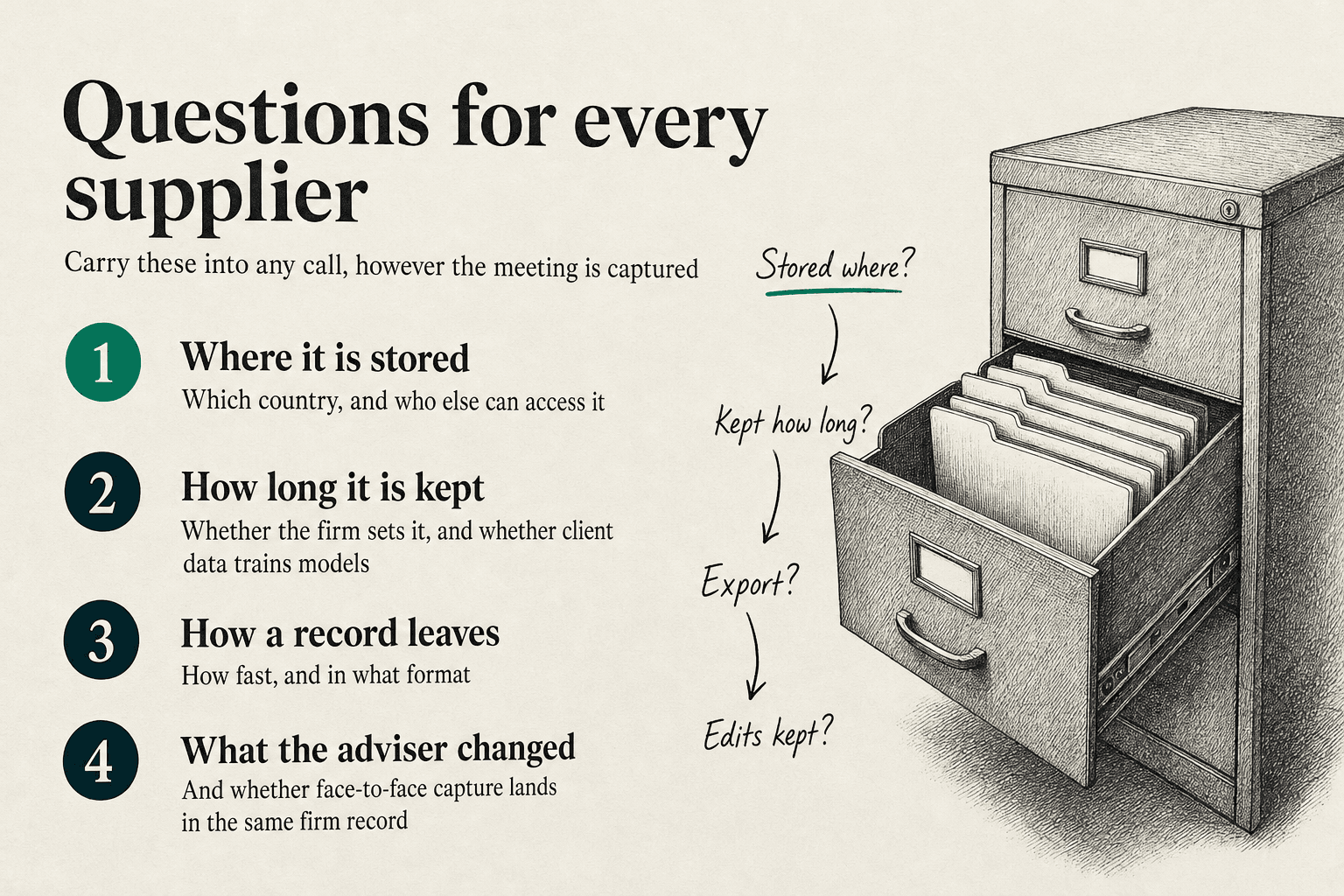
Here are eight questions for any supplier. Each ties back to a rule above. Ask them about every way a meeting is captured, because a lot of Irish advice happens at the office or the kitchen table, not on a video call.
Where it is stored and who else touches it
- Where are the audio and transcript stored, and in which country?
- Who else (sub-processors) can access them?
How long it is kept and what it is used for
- How long are the audio, transcript and draft kept, and can the firm set that?
- Does client data train the supplier's models?
How a record leaves the tool
- How does a full record leave the tool?
- How fast, and in what format? Regulation 118 lets the Central Bank specify both.
What the adviser changed, and where it lands
- Does the tool keep what the adviser changed before approving?
- Does face-to-face capture, whether a phone, dictation or a wearable, land in the same firm record as the online meeting?
The aim is many ways in, one firm record.
The firm stays responsible when a supplier does part of the work, and a person signs off
A firm that knows which tools hold client data, and who checks the output, can answer a client or the regulator in one sentence.
Regulation 119 is short. It says: 'A regulated entity shall ensure that any outsourced activity complies with the requirements of these Regulations.'
An AI supplier handling client material on the firm's behalf is arguably outsourcing. That is our reading, so check it.
The Central Bank's Cross-Industry Guidance on Outsourcing starts from the same place. The regulated firm remains responsible for compliance with its obligations. The guidance also expects a firm to know where its data is stored and how it is secured.
Write the answers down. In a summary of the DPC's report, Arthur Cox noted that high-level statements of compliance without supporting evidence caused delays.
Keep a person in the loop. The DPC's 2024 guidance warns that outputs relied on without human analysis create automated decision-making risk. In plain words, AI drafts and the adviser approves what reaches the file or the client.
Before you bring an AI tool into your file notes and client records, check:
- You can say in one sentence where client audio and transcripts are stored and who else can touch them.
- The supplier has told you in writing whether client data is kept or used to train models.
- Audio, transcript and draft each have a retention period you have chosen, set beside the 6-year record rule.
- A full client record can leave the tool quickly, in a format you could hand to the Central Bank.
- You can see what the adviser changed before approving the note.
- In-person meetings and online meetings land in the same firm record.
- A named person approves every output before it reaches the file or the client, and the supplier is written down in your list of who holds client data.
If the answers come easily, look at tools, and if not, write them down first
If those one-sentence answers come easily, the firm is ready to look at tools. If they don't, writing them down is the work to do first, and it is worth doing whichever tool comes next.
We're building Kaitel with Irish practices ahead of a private launch. You can join the Kaitel waitlist and we'll keep you posted.
Sources
- Irish Statute Book, S.I. No. 81/2025 Central Bank (Supervision and Enforcement) Act 2013 (Section 48) (Consumer Protection) Regulations 2025, made 24 March 2025, in force from 24 March 2026
- Central Bank of Ireland, Consumer Protection Code: General Consumer Protection Requirements (Part 2, Chapters 14 and 15), 24 March 2026
- Central Bank of Ireland, About the Regulations (Consumer Protection Code 2025), 25 March 2026
- Central Bank of Ireland, Regulatory & Supervisory Outlook, 26 February 2026
- Central Bank of Ireland, Speech by Deputy Governor Colm Kincaid, 'Harnessing Opportunity – the Role of Financial Intermediaries in Europe', 19 June 2026
- Central Bank of Ireland, Cross-Industry Guidance on Outsourcing, December 2021
- Data Protection Commission, AI, Large Language Models and Data Protection, 18 July 2024
- Data Protection Commission, Data Protection Commission publishes AI Insights Report, 25 September 2026
- Arthur Cox LLP, The Data Protection Commission's 2026 AI insight report, 29 October 2026
- AI Office of Ireland, Data Protection Commission (national competent authorities), undated page, read November 2026
- AI Office of Ireland, Central Bank of Ireland (national competent authorities), undated page, read November 2026
- Matheson, Irish Artificial Intelligence Act 2026 signed into law, 30 July 2026 (Regulation of Artificial Intelligence Act 2026, signed 21 July 2026)
The meeting ends. Kaitel gets to work.
Early access · 15 Irish practices in January

James Brooks is the founder of Kaitel. An investment analyst turned founder, he works directly with practising Irish advice firms on the paperwork around the client meeting: fact finds, file notes, suitability letters and follow-ups.