
Fact find template for Irish advisers, section by section
What an Irish fact find has to capture, section by section, and the rule behind each part. The statement of suitability can only use what the form gathered, so we show what to write down so you are not ringing the client to finish it.
 James Brooks · Founder, Kaitel · 7 min read
A fact find template for Irish advisers has to capture the client's needs and objectives, personal circumstances, financial situation and, where relevant, attitude to risk. Regulation 16 of the Consumer Protection Regulations 2025 requires the firm to gather and keep a record of enough information before it recommends anything. The statement of suitability then draws on that record, so what the form misses, the statement cannot say.
What's covered
- The statement of suitability can only use what the fact find gathered under Regulation 16, so a gap on the form becomes a gap in the statement.
- Regulation 16 does not cover every firm or service, so check whether it covers yours before you copy a UK or Australian form.
- The rule opens with needs, objectives and personal circumstances, and financial situation and attitude to risk then feed the reasons in the statement.
- Sustainability preferences need their own recorded question now the 2025 rules are in force.
- If a client will not answer a question, the rule sets out what to tell them, and the file should show you did.
The statement of suitability can only use what the fact find captured
In plain terms, an Irish adviser gathers and records enough about the client to give a professional service before recommending a product. Regulation 16 says the information must fit the nature and complexity of the service sought.
The statement of suitability comes next. Under Regulation 18(1), the firm prepares, signs and dates it on paper or another durable medium and gives it to the client.
The link back to the fact find is in Regulation 18(3). The reasons in the statement must apply the information gathered under Regulation 16. They explain how the service meets the client's needs and objectives, personal circumstances and financial situation.
So the reasons can only rest on what was gathered. If the answer is not on the form, it does not reach the statement.
The Consumer Protection Code 2025 has applied since 24 March 2026, so a template written before then may not match it.
Take a three-adviser practice in Galway. We have made it up, but the problem is easy to picture.
Aoife finishes a pension review on a Tuesday afternoon. That evening she starts the statement and reaches the reason about the client's financial situation. The fact find has his salary but no monthly outgoings.
She rings him. He is travelling, so the statement waits a week. The reason could not be written from the file, so the question was missing from the form.
A gap in the fact find becomes a gap in the statement of suitability.
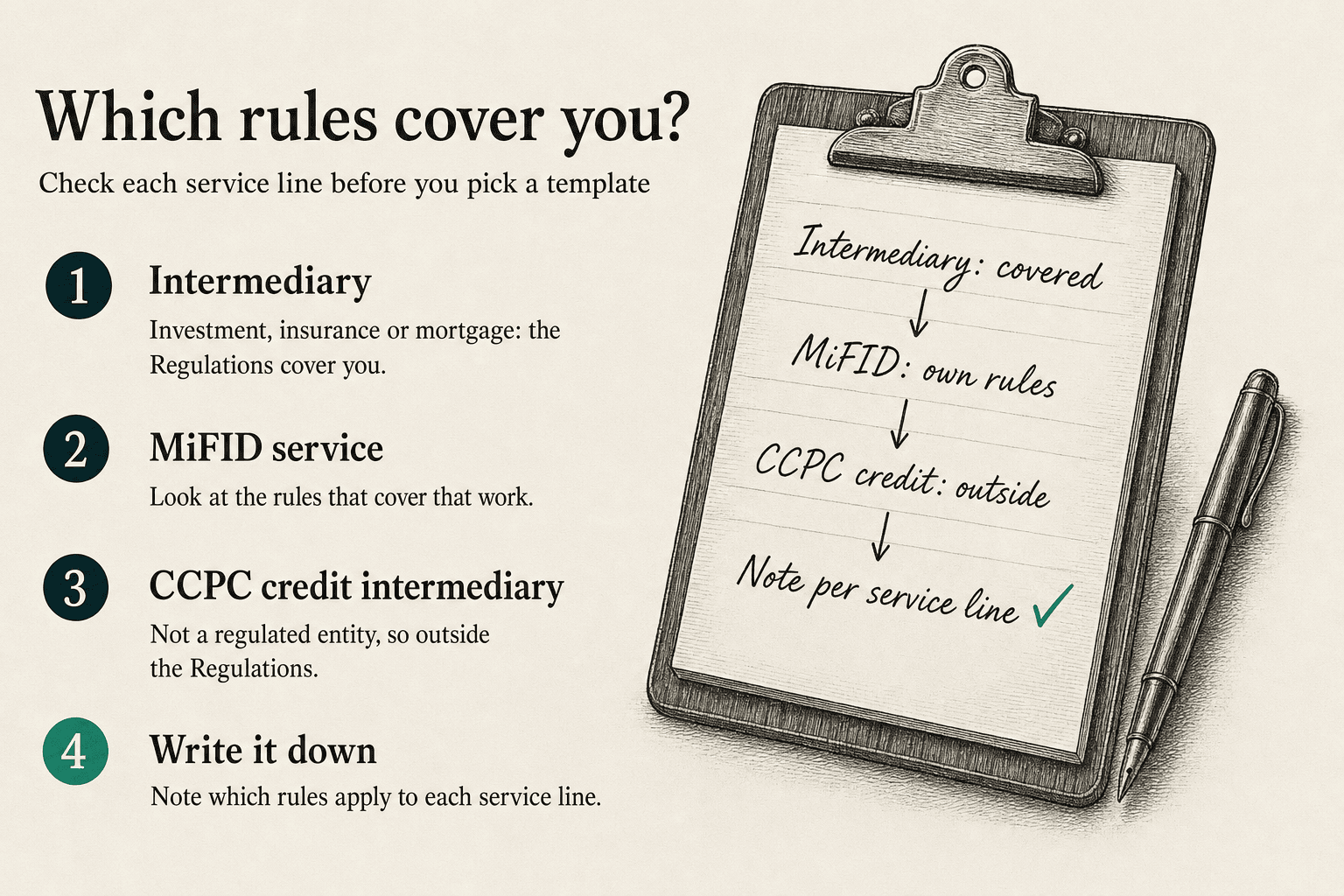
Check which rules cover your firm before you pick a fact find template
The Irish Regulations do not apply to every firm or every service. The UK and Australian forms we looked at do not raise that question.
The Central Bank's General Guidance says the Regulations cover investment intermediaries, insurance intermediaries and mortgage intermediaries.
They do not cover MiFID services (apart from a few the MiFID Regulations carve out), reinsurance, or services to people outside the State. A firm providing MiFID services needs to look at the rules that cover that work.
Credit intermediaries are a separate case. The Central Bank's FAQ says a credit intermediary authorised by the CCPC is not a “regulated entity”, so the Regulations do not apply to it.
Some rules are narrower for some firms. The Regulations have separate headings for insurance distributors, insurance-based investment products and mortgage credit. There is also an exemption from the knowing-the-consumer and suitability rules. Check each against your own service lines.
More than four in ten firms in our count of the Central Bank firm master hold both an investment intermediary authorisation and an insurance intermediary registration. So many firms will need to ask the scope question per service line, not once for the whole firm.
An authorisation is not activity, and MiFID firms cannot be identified in the data.
The fix is a small one. Write down which rules apply to each service line, and pick the template for that line.
A good fact find template opens with objectives and circumstances, because the rule does
The first two things Regulation 16(3) names are needs and objectives, then personal circumstances. A template should open in the same order. Regulation 16 goes on to say more about each, so read it alongside the form.
Start with what the client wants. Record the objective in the client's own words, with a timeframe and a priority, not a tick box.
The statement has to explain how the service meets the client's needs and objectives. A line like “retire early, clear the mortgage first” gives the adviser something to write against. This is our reading of what the statement needs, not Central Bank guidance.
Then record personal circumstances. A template can ask for:
- name, date of birth and address
- marital status and dependants
- employment status
- anything that might make the client vulnerable, noted in the adviser's own words
That list is a suggestion, not a rule. We do not claim a regulation requires any single field.
Date every entry. A dated note shows what the adviser knew when the advice was given, and it is the first thing the statement draws on.
Income, spending, assets and debts make up the financial situation the statement relies on
This section is where the statement's third reason comes from. Regulation 18(3)(c) asks the reasons to explain how the service meets the client's financial situation.
That is why a template should ask for figures, not ranges, with a date beside each one. “About 4,000 a month” gives the adviser nothing to reason from. A figure and the day it was given does.
How much to ask depends on the advice. Regulation 16(2) says the information must be appropriate to the nature and complexity of the service. A simple protection review needs less here than a pension drawdown recommendation, so scale the section to the advice.
This is also where Irish fields matter. The UK and Australian forms we looked at have no obvious home for several fields Irish practices will recognise:
- PPS number
- ARF and AVC
- Death in Service
- tracker mortgages
- Irish tax status
These are template fields only. We make no rule or tax claim for any of them.
Attitude to risk and sustainability preferences each need their own recorded answer
The 2025 rules treat these as separate answers, so a template with a single risk page may miss the second.
Start with attitude to risk. Where relevant, the statement must outline how the risk profile of the product is aligned with the client's attitude to risk. It asks the same of the nature, extent and limitations of any guarantee attached to the product.
So record the client's attitude, how the questionnaire answer was reached, and whether a guarantee mattered to them.
Sustainability preferences are the second answer. The statement must identify where the service meets any preferences the firm gathered under Regulation 16. Those preferences sit outside the main reasons in the statement, so they need their own question on the form.
The General Guidance (3.3.4) gives the order. Gather preferences under Regulation 16, then assess suitability on needs, circumstances, financial situation and attitude to risk. Check sustainability features last.
A form written before March 2026 can lack the question. Check yours.
If a client will not answer, the rule says what to tell them, so write it down
Some clients decline a question. If a client will not answer, you tell them you cannot go ahead. The Central Bank's text of Regulation 16(11) is plain.
Where a client refuses to provide the information requested, the firm “shall inform the consumer that, as it does not have the relevant information necessary to assess suitability, it cannot offer, recommend, arrange or provide the consumer the financial service sought.”
The General Guidance at 3.3.7 repeats the point. Without the relevant information, suitability cannot properly be assessed.
Our reading is that the file should show the question, the client's answer or refusal, and what the adviser told them. That follows from the duty in Regulation 16(1) to keep a record.
We do not claim the Regulations require a signed or certified fact find. That was a feature of the 2012 Code, and we could not confirm it for the 2025 rules.
Check the template before a client sees it
Before you use a fact find template with a client, check:
- It says which service line and which rules it is written for, and whether Regulation 16 covers that service.
- Objectives are recorded in the client's own words, with a timeframe and a priority.
- Personal circumstances, including dependants and anything that makes the client vulnerable, are noted and dated.
- Income, spending, assets and debts are in figures, with the date they were given.
- Attitude to risk is recorded with how it was reached and whether a guarantee mattered.
- Sustainability preferences have their own question, asked before the recommendation.
- Anything the client declined is written down with what you told them, and the form prompts you to ask what has changed before any further service (Regulation 16(9)).
The quickest test of a fact find is the last statement of suitability written from it. Any reason that needed a call to the client to finish points to a field the form is missing.
We're building Kaitel with Irish practices, and you can join the waitlist for the private launch at the foot of that page.
Sources
- Irish Statute Book, S.I. No. 81/2025, Central Bank (Supervision and Enforcement) Act 2013 (Section 48) (Consumer Protection) Regulations 2025, 24 March 2025
- Central Bank of Ireland, General Consumer Protection Requirements (Part 2 of S.I. 81 of 2025), 24 March 2025
- Central Bank of Ireland, General Guidance on the Consumer Protection Code, updated September 2026
- Central Bank of Ireland, Consumer Protection Code FAQ
- Central Bank of Ireland, Consumer Protection Code
- Kaitel, count of firms by authorisation type in the Central Bank firm master (1,135 of 2,616 firms hold both an investment intermediary authorisation and an insurance intermediary registration), 29 September 2026
The meeting ends. Kaitel gets to work.
Early access · 15 Irish practices in January

James Brooks is the founder of Kaitel. An investment analyst turned founder, he works directly with practising Irish advice firms on the paperwork around the client meeting: fact finds, file notes, suitability letters and follow-ups.