
Minimum Competency Code: what Irish firms must show (2026)
Which minimum competency code is in force, who it covers, and what the Central Bank found when it looked at firms in 2024. Then a plain list, our reading and not a regulator's checklist, of the records a small Irish practice should be able to put in front of the Central Bank.
 James Brooks · Founder, Kaitel · 8 min read
The Code in force is the Minimum Competency Code 2017, with the Minimum Competency Regulations 2017, in effect since 3 January 2018 and replacing the 2011 Code (Central Bank of Ireland, undated page, read 29 October 2026). Under the Regulations a firm must keep a register of accredited persons and records of new entrants, CPD and annual reviews (S.I. 391 of 2017, 1 September 2017).
Look, the first job is to settle which version people are reading, because pages describing the 2011 era still rank. On 23 October 2026 we counted 2,701 distinct firms on the Central Bank's insurance, investment and mortgage intermediary registers, and nearly half sit on more than one (Kaitel count of the Central Bank register, as at 23 October 2026). That counts firms, not advisers or the work they do. So this post follows the Central Bank's own documents, with dates.
Which version of the minimum competency code applies now, 2011 or 2017?
The Minimum Competency Code 2017 and the Minimum Competency Regulations 2017 apply now. Together they replaced the Minimum Competency Code 2011 from 3 January 2018 (Central Bank Q&A, June 2026). A page that treats the 2011 Code as current is out of date. The dates, in order:
- 1 January 2007: the Minimum Competency Requirements 2006 start, replaced by the 2011 Code on 1 December 2011 (Central Bank Q&A, June 2026)
- 1 September 2017: the 2017 Code and Regulations are issued, after the 2016 review (S.I. 391 of 2017, 1 September 2017)
- May 2022, September 2023, June 2024 and June 2026: addenda covering retail credit, credit unions, sustainability and crypto-assets (Central Bank page, undated)
- 28 July 2026: an unofficial consolidation takes effect, “for ease of reference only” and not a legal document (Central Bank consolidation, June 2026)
The Regulations were amended by S.I. 234 of 2022, S.I. 453 of 2023 and S.I. 295 of 2026 (Central Bank page, undated). Liabilities under the 2011 Code survive its replacement, so action for an old breach can still be taken (Central Bank consolidation, June 2026). The June 2026 crypto-asset addendum applies to crypto-asset service providers, not to an ordinary advice practice (William Fry, 9 July 2026).
Who the minimum competency code covers and what it asks of each person
The Code applies by the function a person performs, not by job title. A regulated firm must also ensure that people performing a relevant function on its behalf, including outsourced third parties, comply with it (Regulation 3, as substituted by S.I. 295 of 2026, 25 June 2026).
Who is covered
The Code has three parts. Part 1 covers controlled functions: advising on or giving information about retail financial products to consumers, arranging them, and specified functions such as supervising accredited persons or adjudicating complaints about advice. Part 2 covers additional functions such as certain MiFID services, product design and mortgage credit, which mainly relate to non-consumer activity. Part 3 covers recognised qualifications (Central Bank Q&A 1.1, June 2026).
Qualifications and grandfathering
A qualification is recognised if it is listed at Appendix 4 of the Code (S.I. 391 of 2017, 1 September 2017). A newly recognised qualification must sit at Level 7 or higher on the National Framework of Qualifications (Central Bank Q&A, June 2026).
Grandfathering is a closed historical route. Under Section 1.5 a person qualified this way was dealing with the relevant product on 1 January 2007 and had four years' experience (CPA Ireland copy of the Code 2017, undated).
CPD: 15 hours, one of them on ethics
The Code asks for 15 hours of CPD a year, and Regulation 7(3)(b) refers to “15 hours of CPD, as required by the Minimum Competency Code” (S.I. 391 of 2017, 1 September 2017). At least one of those hours must relate to ethics (Section 1.7, in the CPA Ireland copy of the Code 2017, undated).
Say you're three advisers in Galway and one of you is grandfathered. The same 15 hours apply to all three.
What changed on 28 July 2026 for an adviser's client list
The 2026 change that touches ordinary advisers is the definition of consumer. S.I. 295 of 2026 was made on 25 June 2026, notice appeared in Iris Oifigiúil on 26 June, and it came into operation on 28 July 2026 (S.I. 295 of 2026, 25 June 2026). William Fry reports that it aligns the definition with the Consumer Protection Code 2025 (William Fry, 9 July 2026), which took effect on 24 March 2026 (Central Bank newsletter, June 2026).
In the 2017 Regulations an incorporated body counted as a consumer only with turnover of €3,000,000 or less in the previous financial year (S.I. 391 of 2017, 1 September 2017). Now it counts as a consumer unless it had turnover “in excess of €5 million” in the previous financial year, or is in a group of companies with combined turnover greater than €5 million (S.I. 295 of 2026, 25 June 2026).
Say a client of yours is a Galway company with €4 million turnover and no group. Under the old wording it sat outside the definition. Under the new wording it sits inside. I might be wrong on how a given firm applies this, so whoever handles your compliance is the right person to ask.
What the Central Bank found when it looked at firms in 2024
The Central Bank's industry letter of 29 May 2024 reported on a thematic review of the Minimum Competency Code and the Consumer Protection Code. The firms reviewed ran from sole traders to large intermediaries and served about 25 percent of the consumers served by retail intermediaries. The volume and severity of risks and breaches were “far greater in smaller, independent Retail Intermediaries” (Central Bank of Ireland, 29 May 2024).
Several firms could not produce adequate evidence or documentation. Some registers “fell short of the requirements in terms of format, clarity and detail” under Regulation 7, and it was not clear they had been adequately updated or maintained. The letter blamed inadequate internal processes and poor record keeping and file management (Central Bank of Ireland, 29 May 2024).
Among the good practices it listed was regular scheduled reviews of the MCC registers. It asked firms to document a review and have a management-approved action plan by 31 August 2024, and said it expects that document in future engagements. The line that stayed with me: “every Retail Intermediary should be able to demonstrate a minimum standard of compliance in terms of MCC and KYC/Suitability” (Central Bank of Ireland, 29 May 2024).
The same letter found documents that could not be retrieved in time, which our recent post on client files covers. In June 2026 the Central Bank started a mapping and profile review of the retail intermediary sector (Central Bank newsletter, June 2026).
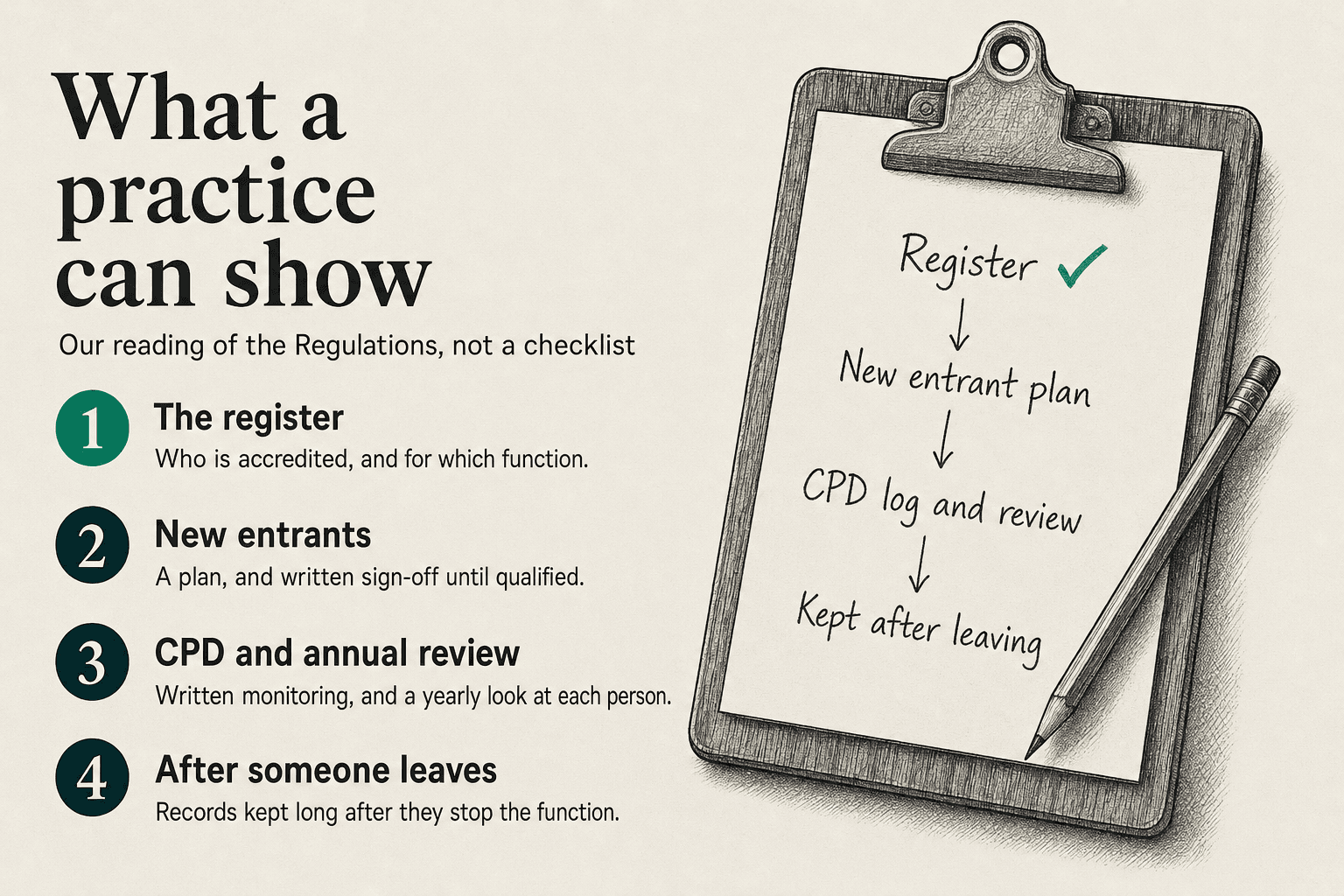
What a practice should be able to show under the minimum competency code
A word first. I am an investor, not an adviser, and this is our reading of the Regulations, not a Central Bank checklist. They point to five things a firm should be able to put on the table: the register of accredited persons, the new entrant plan with supervision and sign-off records, the CPD monitoring records, the internal annual review, and the records kept after someone leaves (S.I. 391 of 2017, 1 September 2017 and S.I. 295 of 2026, 25 June 2026).
The register
Regulation 7 asks for the person's name, their qualification or status (grandfathered, transitional, new entrant or prescribed script), the relevant function and product, and the date the qualification and experience were completed. For a new entrant it adds the start date and the qualification being pursued. Each branch keeps a register of its own people, and a person comes off if their professional designation lapses for failing CPD (S.I. 391 of 2017, 1 September 2017). The date field now reads as substituted by S.I. 295 of 2026, 25 June 2026.
New entrants
Regulation 9 asks for an agreed plan to a recognised qualification, which the firm monitors. Until the person has one, all documentation for the function must be checked and approved in writing by a qualified person (S.I. 391 of 2017, 1 September 2017, with Regulation 9(1)(b) and 9(2)(a) as substituted by S.I. 295 of 2026, 25 June 2026). Regulation 10 asks for written records starting from the date the person began the function (S.I. 391 of 2017, 1 September 2017).
Say Aoife is the newest of three advisers in a Galway practice and started in September. Her sign-off belongs on her file and not in a colleague's inbox.
CPD records and the annual review
Regulation 13 asks for an internal annual review of each person's qualifications, checking each suits their function, and of their development and experience needs, taking account of regulatory developments and any new retail financial products the firm offers (S.I. 295 of 2026, 25 June 2026). Regulation 15 asks for written records of CPD monitoring (S.I. 391 of 2017, 1 September 2017).
How long to keep it all
Regulation 17(2) says records are kept for a minimum of 6 years after the person ceases to perform a relevant function for the firm. Paragraph (3) carries exceptions this post does not cover, so check the full text. Regulations 11 and 12 add the Statement of Grandfathered Status, given to a grandfathered person on leaving or on request, and the records needed to recreate it (S.I. 391 of 2017, 1 September 2017).
Questions advisers ask about the minimum competency code
Can AI training count towards CPD under the minimum competency code?
Yes, where the training is directly relevant to the person's functions and to one or more Appendix 3 competencies for the relevant product. The Code itself sets no AI competencies (Central Bank Q&A 2.7, added 27 November 2025, in the June 2026 Q&A).
Can spare CPD hours be carried into the next year?
No. Surplus hours in one year cannot be carried into the next (Section 1.7, in the CPA Ireland copy of the Code 2017, undated). That is a copy of the Code, so check it against the Central Bank's own text.
Where this leaves a small practice
The list above is my reading, and what is enough for a given firm is a matter for its own compliance support and the Central Bank's minimum competency pages. The Central Bank has said a firm must be able to demonstrate its compliance on a continuous basis (Central Bank of Ireland, 29 May 2024). A practice can find out how long it takes to pull its register and CPD log together by trying it one afternoon.
We have been building Kaitel with a small group of Irish advice practices, around the paperwork after the client meeting, ahead of a private launch. A practice that wants to be kept posted can join the waitlist at the foot of that page.

The meeting ends. Kai starts.
Founding cohort · Irish advice firms
Not ready yet? Join the waitlist

James Brooks is the founder of Kaitel. An investment analyst turned founder, he works directly with practising Irish advice firms on the paperwork around the client meeting: fact finds, file notes, suitability letters and follow-ups.