
Statement of suitability in Ireland: what to include (2026)
What an Irish statement of suitability has to contain under the Central Bank's rules in force since 24 March 2026, a six-part structure to follow, and how it links back to the fact find and the file behind it.
 James Brooks · Founder, Kaitel · 7 min read
A statement of suitability is the document the Central Bank's consumer protection rules ask you to sign and date. You give it to the client before you provide or arrange a service. It explains why the service suits them, using your fact find, and the rules have applied since 24 March 2026.
Key Takeaways
- A statement of suitability is signed, dated and with the client before you provide or arrange the service.
- Advice on insurance-based investment products and MiFID services follows other rules, so check the case first.
- The statement opens with a fixed notice, then gives reasons under three headings the rule names.
- Every reason should trace back to a line in the fact find.
- Record any oral explanation with the statement, and keep the file behind it.
A statement of suitability is signed, dated and with the client before you act
Yes, it is signed and dated. Under Regulation 18(1), the statement goes to the client before you provide or arrange the service.
“prepare, sign and date a statement of suitability on paper or on another durable medium” (Reg 18(1))
The new Consumer Protection Regulations came into operation on 24 March 2026. Older pages, including Irish blog posts, describe the Consumer Protection Code they replace. Some of those pages call it a “reason why” statement, which is an older name.
There is one timing exception, and it is for insurance. Where a client needs immediate cover, the Central Bank's insurance rules let you issue the statement before the policy is entered into or within 5 working days of it.
Check the case needs a statement of suitability under Regulation 18 before you start
Regulation 18 is not the only suitability statement. Some advice sits outside it, so settle which rule applies before you write anything.
These cases fall outside it:
- Advice on insurance-based investment products. The Central Bank's rules say the suitability chapter does not apply to it. EU law has its own suitability statement for these products, so look there.
- MiFID services. The Central Bank's General Guidance says the Regulations do not apply to MiFID services, with one narrow exception. If you give MiFID investment advice, you work to MiFID suitability reporting instead.
- Debt management services. The rule itself says it does not apply to them.
We do not cover mortgage credit cases here.
In October we counted the Central Bank's registers, and 1,204 firms sit on both an insurance intermediary register and an investment register. Being on two registers does not mean trading in both. But many firms will meet this rule on some cases and a different rule on others, so check case by case.
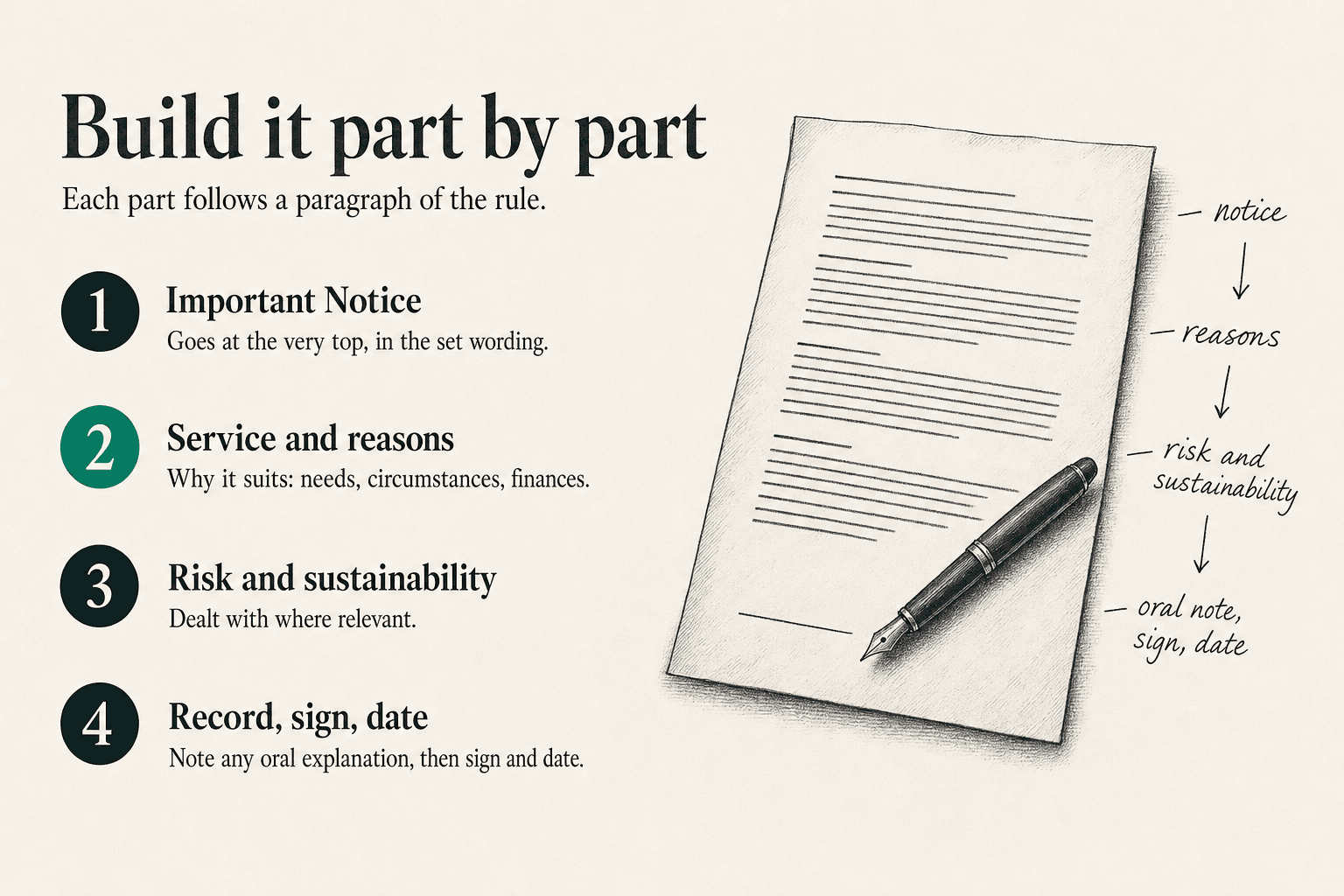
Build the statement of suitability in six parts, each tied to a paragraph of Regulation 18
The order below is ours, built from the paragraphs of Regulation 18. The rule fixes only one position, which is the Important Notice at the start.
- The Important Notice at the very top (Reg 18(6)).
- The service offered and why it is suitable, or why each option in a selection is (Reg 18(2)).
- Your reasons, covering needs and objectives, personal circumstances, and financial situation, where relevant (Reg 18(3)).
- How each element in the rule's list aligns with the client's attitude to risk, where relevant (Reg 18(4)).
- Where the service meets any sustainability preferences you gathered (Reg 18(5)).
- A record of any oral explanation, in the statement or with it, then your signature and the date (Reg 18(7) and 18(1)).
The notice has a set format. As amended this year, the Important Notice must read: “Important Notice – Statement of Suitability. This is an important document which sets out the reasons why the product(s) or service(s) offered or recommended is/are considered suitable, or the most suitable, for your particular needs, objectives and circumstances.”
We have left out the list the rule gives for attitude to risk. Read it on the Central Bank's page for Part 2 before you finalise your template.
One warning comes from a law firm, not the Central Bank. A&L Goodbody wrote this in March 2025, before the amendments: “It is not sufficient to note that a product or service is suitable because it aligns with the customer’s risk tolerance.” So give the reasoning, not only the match.
Each reason in the statement of suitability should trace back to a line in the fact find
The rule ties your reasons to the information you gathered under Regulation 16. So each reason should point to something the client told you.
The reasons have to support a standard set in Regulation 17(5): a recommended product must be “the most suitable product for that consumer”. That is a separate rule from the statement itself.
Take a three-adviser practice in Galway. It is made up. Niamh is one of the advisers, and she is advising a couple, Colm and Aoife, on life and income protection alongside a new mortgage.
Niamh has been retyping the same fact find answers into the statement and then into the file note. Her first draft of the statement says the cover is suitable for their circumstances. That sentence fits any client's statement.
So she rewrites it as three short paragraphs, one for each area the rule names. Each has a clause pointing to the fact find answer behind it:
- Needs and objectives: clear the mortgage and replace income if either of them dies or cannot work.
- Personal circumstances: two young children, and Colm is self-employed.
- Financial situation: what the monthly budget can carry.
The statement now reads in about a page, and Colm and Aoife can see their own answers in it. It also showed one gap, an unanswered question on existing cover, which she went back and asked.
The lesson is simple. If you cannot point to the fact find line behind a reason, either the reason goes or the fact find has a gap.
That re-keying between fact find, statement and file note is the after-meeting paperwork we are building Kaitel to help with. It is a working prototype, shaped with Irish practices around their own documents and processes.
The statement is what the client reads and the file behind it is what you keep
The text we read does not use the phrase “record of advice”. It sets out several record duties around the statement, and no single rule creates one document.
Here are the duties we could source:
- Gather and keep a record of sufficient information before you offer, recommend, arrange or provide a service (Reg 16(1)).
- As amended this year, Regulation 16(9) says that before a further service you seek confirmation of any material changes, gather that information and keep a record of it.
- As amended this year, Regulation 16(13) says you endeavour to ensure the client certifies the accuracy of the information they gave you.
- Assess and document whether the service is suitable (Reg 17(2)). That documented assessment is separate from the statement the client receives.
- Include a record of any oral explanation in, or with, the statement (Reg 18(7)). This is the direct link between the meeting and the document.
Then there is retention. The retention rule is six years, but the clock starts at different points. For transaction records it starts when the transaction is discontinued or completed. For other records it starts when you stopped providing any financial service to the client.
Check the exceptions in that regulation, because six years is not the answer for everything.
Seven checks before a statement of suitability goes to the client
Before you send a statement of suitability, check:
- The case is one Regulation 18 covers, and not advice on an insurance-based investment product or a MiFID service.
- The Important Notice sits at the very beginning, in the Central Bank's wording.
- Every reason sits under needs and objectives, personal circumstances or financial situation, and points to a fact find answer.
- Attitude to risk and any sustainability preferences are dealt with where relevant, against the Central Bank's text.
- Any oral explanation you gave is recorded in or with the statement.
- The client has been asked to certify the information they gave, and the fact find is on file.
- It is signed, dated and with the client before you act, bar the urgent insurance exception.
Start with the last statement you sent
Take the last statement of suitability you sent and trace each reason back to a line in the fact find. Wherever the trail stops, that is the part of the process to tighten first.
If you want to hear about what we are building with Irish practices, join the Kaitel waitlist.
Sources
- Central Bank of Ireland, General Consumer Protection Requirements, Part 2 of the Consumer Protection Regulations 2025 (Regs 16 to 18, 115 to 117), 24 March 2025 (page carries the 2026 amendments)
- Central Bank of Ireland, Preliminary and General, Part 1 of the Consumer Protection Regulations 2025 (Regs 1, 11), 24 March 2025
- Central Bank of Ireland, Insurance, Part 4 of the Consumer Protection Regulations 2025 (Reg 340), 24 March 2025
- Central Bank of Ireland, General Guidance on the Consumer Protection Code, March 2026, last updated September 2026
- Irish Statute Book, S.I. No. 81/2025, Consumer Protection Regulations 2025 (print version), 24 March 2025
- Irish Statute Book, S.I. No. 111/2026, Consumer Protection (Amendment) Regulations 2026, 25 March 2026
- A&L Goodbody, Consumer Protection Code Review: What you need to know, March 2025
- European Commission, Commission Delegated Regulation (EU) 2017/2359, 21 September 2017
- Irish Mortgage Brokers (Karl Deeter), Definitions: The 'Reason Why' statement or 'Statement of Suitability', 21 January 2013
- Kaitel, count of firms on the Central Bank of Ireland registers, 23 October 2026

The meeting ends. Kai starts.
Founding cohort · Irish advice firms
Not ready yet? Join the waitlist

James Brooks is the founder of Kaitel. An investment analyst turned founder, he works directly with practising Irish advice firms on the paperwork around the client meeting: fact finds, file notes, suitability letters and follow-ups.