
MCC qualification: check it's on the Central Bank list
Is your course on the Central Bank's list? The list names designations, not course titles, so here is how to match a course to its designation, check your product categories and date your own check.
 James Brooks · Founder, Kaitel · 7 min read
An MCC qualification is a qualification listed in Appendix 4 of the Central Bank's Minimum Competency Code, such as the QFA or an APA designation. To check one, find the product category you will advise on in the Central Bank's list and look for the designation, not the course title. We read the list on 10 November 2026.
Exec Summary
- An MCC qualification is a designation on the Central Bank's list, and the list is what counts, not a course page or an AI summary.
- QFA is recognised for five of the eight retail product categories, so it does not cover every adviser's work.
- The list names designations, so searching it for a course title and finding nothing proves nothing.
- A trainee on a supervised plan has four years and must register for the first available exam sitting, so exam dates belong in the choice of provider.
- The list page shows no update date, so a dated note of your own check is your record.
An MCC qualification is a designation listed in the Central Bank's Appendix 4
The Code gives the term a plain meaning. A recognised qualification is one listed at Appendix 4 of the Code, and a qualified person holds one that is relevant to the function they perform.
So the test is short. Is the designation on the list, for the product category the adviser will work in?
There is no single MCC exam or certificate. The Central Bank's list holds many designations, each recognised for particular products and roles. It has three parts:
- Part 1: qualifications by category of retail financial product, such as Qualified Financial Adviser (QFA), Accredited Product Adviser (Pensions) and Certified Insurance Practitioner.
- Part 2: extra qualifications for specific roles, including credit unions acting as insurance intermediaries, amendments to life policies and pensions, claims and complaints.
- Part 3: debt management services.
A qualification gained abroad does not count unless it is specifically recognised by law, as the Central Bank's Q&A says. Someone with another qualification can ask the Irish professional bodies for an exemption from part of the exams.
The Central Bank takes no part in course design or exams. That sits with the bodies that award the qualifications.
QFA is recognised for five of the eight product categories
The list is organised by eight categories of retail product. A designation counts only for the categories it appears under.
On our read of the live list, QFA appears under these five:
- Life Assurance
- Pensions
- Savings and Investments
- Housing Loans
- Consumer Credit
It does not appear under Personal General Insurance, Commercial General Insurance or Private Medical Insurance. Those rows list other designations, including Certified Insurance Practitioner, Associate or Fellow of the Chartered Insurance Institute, and the Accredited Product Adviser or Professional for that category. Private Medical Insurance also lists the Insurance Institute's Diploma in Private Medical Insurance.
Other designations are just as specific. Registered Stockbroker, for example, covers Savings and Investments only.
Providers say the same. LIA describes QFA as meeting the Code for five categories, not the full set. We have seen course pages and AI summaries say QFA covers every retail product, and the list does not support that.
Take a made-up trainee, Aoife, who has just joined a three-adviser practice in Galway. The practice does mortgages and life cover, and also home and motor insurance for existing clients.
Aoife planned to enrol on a QFA course, assuming it covered all of that. She read Part 1 row by row and found QFA under mortgages and life, but not under Personal General Insurance. So she asked the practice which categories she would actually advise on before she paid.
The lesson: a designation is recognised category by category, so match it to the work.
Search the list for the designation, because it never names the course
Here is the trap that catches people before they pay. The Central Bank list names designations, and providers name courses.
So a search of the list for a course title finds nothing, even when the course is a route to a recognised designation.
Here are two real examples. IOB's Professional Diploma in Financial Advice is a UCD award, and holders are invited to apply for the QFA designation. LIA sells a differently named course, the Certificate in Professional Financial Advice, which also awards QFA.
The course name changes by provider. The list entry, QFA, stays the same.
The list names designations. Providers name courses.
That is why two questions belong with every provider:
- Which designation does the course lead to?
- Is it awarded on completion, or by invitation or application afterwards?
Ask what it takes to keep the designation too. IOB says continued use of QFA is subject to annual CPD, so the cost does not stop at the exams.
To check an MCC qualification, start with the product category
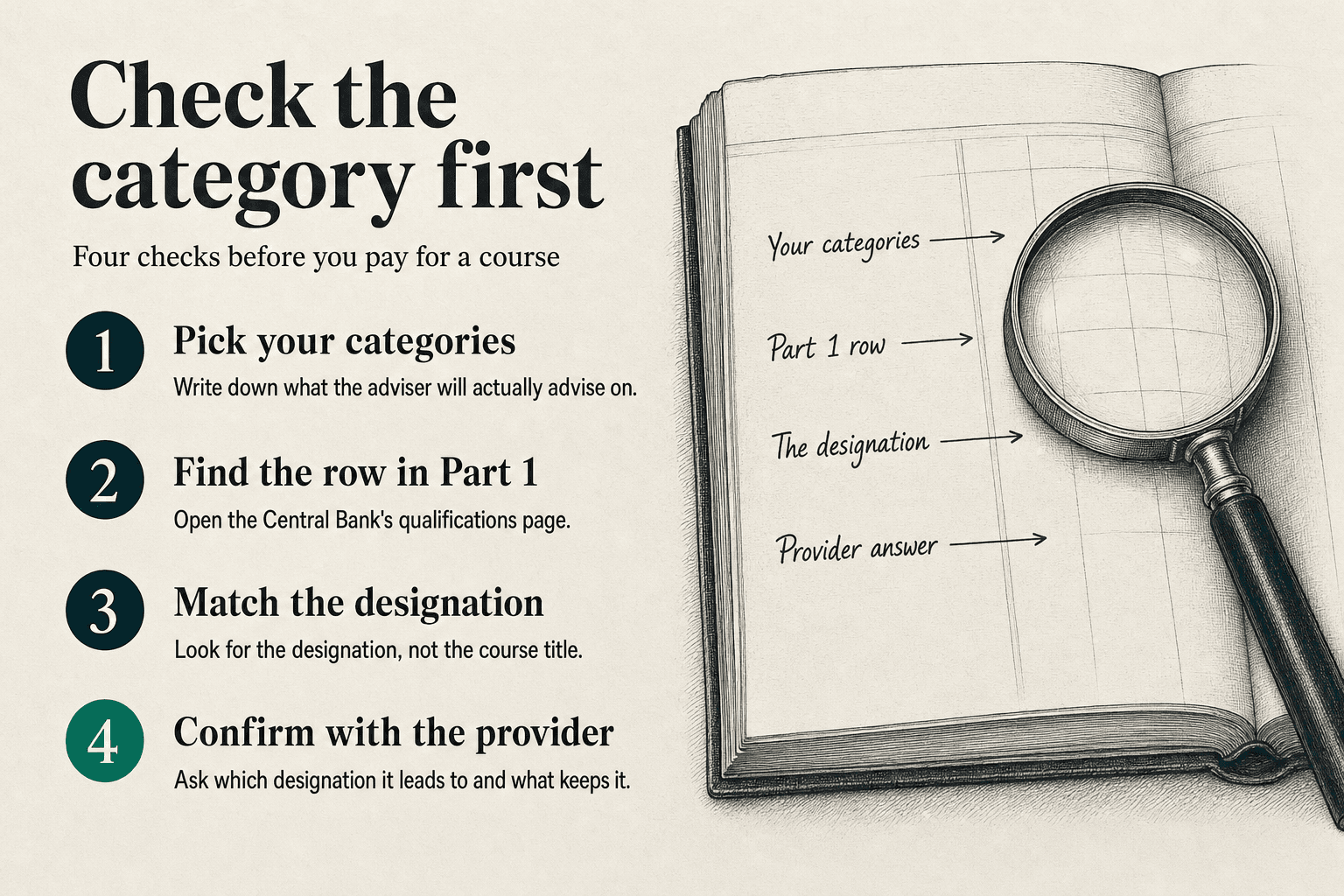
To check whether a qualification is recognised under the Minimum Competency Code, start from the work, not the course. Part 1 of the list recognises qualifications for retail financial products and the functions that go with them, so the check runs by category.
Here is the check. It takes about ten minutes.
- Pick your product categories. Write down the categories the adviser will actually advise on, such as life, pensions or mortgages.
- Find the row in Part 1. Open the Central Bank's qualifications page and go to that category's row.
- Match the designation. Look for the designation in that row, not the course title.
- Confirm with the provider. Ask which designation the course leads to, whether it comes on completion or by invitation afterwards, and what it takes to keep it.
A provider's programme page usually states the designation and categories. IOB's page for its diploma lists the same five categories we found QFA under, which is a useful cross-check.
Then save a dated copy of the row you checked, as a screenshot or a saved page. The page does not date itself, so your copy is the record. We come back to this in the last section.
A trainee has four years, so exam dates matter when choosing a provider
For a new entrant working under supervision, the qualification is on a clock. The 2017 Code sets a maximum of four years in total for the training process.
The new entrant must register for the first available sitting of the relevant exam they could reasonably be expected to sit. After a fail, they register for each available sitting until they qualify. The Central Bank's consolidated text of the Code says this, and says it is for ease of reference only.
They also keep a record of exams completed, results and exams scheduled. Until they qualify, a person who meets the standards checks and approves their documents in writing.
The firm agrees a plan with the trainee for getting the recognised qualification, under S.I. 295 of 2026.
The route to the qualification is the exam route through a provider. So the next sitting matters.
Providers hold only a few sittings a year, and each has a registration cut-off. On the day we read it, LIA's QFA page showed sittings in January, May and September. So missing a cut-off can mean waiting for the next sitting.
The list shows no update date, so date your own check
The Central Bank's list page does not say when it was last updated, and we will not guess a date. What we can say is what we saw.
We read it on 10 November 2026.
Its newest dated entry is the Credit Union Pathways Diploma in Governance with Consumer Credit Bridging Module, marked from 23 September 2025. So the list was updated no earlier than that, and the page does not say when.
The Central Bank's main Minimum Competency page shows its Q&A as updated in June 2026. That is a different document, so it does not date the list.
The page also still says that further credit union qualifications will be recognised from 1 October 2024. That reads as out of date, because the Q&A says they were recognised when credit unions came into scope.
Credit union designations on the list are tied to credit union work and sit against only some categories, so read the row before assuming one carries over.
So the habit is simple. Save a dated copy of the row you checked, and write the date beside it.
Before you enrol on a course, check:
- I know which product categories I will advise on.
- I have found each category's row in Part 1 of the Central Bank's list.
- The designation the course leads to is in that row.
- The provider has told me in writing whether the designation is awarded on completion or by application afterwards.
- I know what it costs and takes to keep the designation, such as annual CPD.
- I know the next exam registration date and how it fits my four years.
- I have saved a dated copy of the list page.
The Central Bank list is the record that counts. If a course page and the list seem to disagree, the list wins, and your saved, dated copy of the row is what you can show your firm.
We're building Kaitel with Irish advice practices, to do the file notes and follow-ups after the client meeting. Join the Kaitel waitlist. The waitlist form is at the foot of that page.
Sources
- Central Bank of Ireland, Qualifications (list of recognised qualifications, Parts 1 to 3), read 10 November 2026, page shows no date
- Central Bank of Ireland, Minimum Competency Code and Minimum Competency Regulations 2017, Q&A updated June 2026
- Central Bank of Ireland, Minimum Competency Code 2017 and MCR 2017 Questions and Answers, updated June 2026
- Central Bank of Ireland, Unofficial Consolidated Minimum Competency Code, June 2026, effective 28 July 2026
- Central Bank of Ireland, Minimum Competency Code 2017, 2017
- Irish Statute Book, S.I. No. 295/2026, Central Bank (Supervision and Enforcement) Act 2013 (Section 48(1)) (Minimum Competency) (Amendment) Regulations 2026, 25 June 2026
- IOB, Professional Diploma in Financial Advice (QFA), read 10 November 2026, page shows no date
- LIA, QFA | Certificate in Professional Financial Advice, read 10 November 2026, page shows no date
The meeting ends. Kaitel gets to work.
Early access · 15 Irish practices in January

James Brooks is the founder of Kaitel. An investment analyst turned founder, he works directly with practising Irish advice firms on the paperwork around the client meeting: fact finds, file notes, suitability letters and follow-ups.