
File note template for Irish advisers: what each part is for
A file note template for Irish advisers in five parts. Each part is tied to what the Central Bank's 2025 Consumer Protection Regulations expect on the record, so you can see where your own notes might be thin.
 James Brooks · Founder, Kaitel · 8 min read
A file note is your own dated record of a client meeting: who was there, what the client told you, what you discussed and recommended, and what happens next. This post gives a file note template in five parts and ties each part to what the Central Bank's 2025 Consumer Protection Regulations expect on the record.
When we searched 'file note template' for this post, the first results were Word forms, Pinterest pins and a law firm sample. They were written for HR, solicitors and employee incidents, and none of them mentioned Irish financial advice or the Central Bank. So this is the version an Irish adviser might actually want open after a client meeting.
What is a file note, and how is it different from the statement of suitability?
A file note is the adviser's own record of what happened in a client meeting, dated and kept on the client's file. The statement of suitability is a different document. Regulation 18(1) says the firm must 'prepare, sign and date a statement of suitability on paper or on another durable medium' and provide it to the consumer (Central Bank of Ireland, 24 March 2025, in force from 24 March 2026). The note stays with you. The statement goes to the client.
The two are linked, though. Regulation 18(3) says the reasons in the statement 'shall apply the information gathered under Regulation 16(1) to (10)' (Central Bank of Ireland, 24 March 2025). So a thin record of the meeting leads to thin reasons on the page the client reads.
I should say plainly that no source we read calls a 'file note' a required document. Regulation 16 says to 'gather and keep a record of sufficient information' (Irish Statute Book, 24 March 2025), and Regulation 17 says to assess and document suitability. The layout below is one way to hold all of that in one place.
Many practices gather this information on a fact find, and the Central Bank's 2024 letter refers to the 'KYC fact-find' (Central Bank of Ireland, 29 May 2024). I read a search for 'record of advice template' as a search for the statement of suitability, the separate document above.
What the Central Bank found missing from adviser files, and why a generic file note template won't catch it
Generic templates carry a date, a list of attendees and a space for notes. The Central Bank's findings on intermediary files were about other things. They come from its industry letter of 29 May 2024 and its Intermediary Times of June 2024. They were written under the 2012 Code, which the 2025 rules replaced on 24 March 2026, and they concern the KYC and suitability documents rather than file notes as such.
Firms were 'unable to retrieve specific documentation in a timely manner' (Central Bank of Ireland, 29 May 2024). There was reliance on 'out of date or insufficiently detailed KYC information' and a 'lack of signatures and dates on the KYC and Suitability document'. Some statements of suitability 'did not reflect current circumstances', and in places 'generic Statement of Suitability templates used'.
The June 2024 newsletter put the cause down to 'inadequate or ineffective internal processes and controls, and general poor record keeping and file management' (Central Bank of Ireland, June 2024).
The letter also said 'the volume and severity of the risks and breaches identified were far greater in smaller, independent Retail Intermediaries'. The sample covered firms serving 'approximately 25 percent of the total retail consumers serviced by Retail Intermediary firms in Ireland', so it is a slice of the market, not all of it (Central Bank of Ireland, 29 May 2024).
Each finding has a part of the layout that answers it. Retrieval and dates go to the header. Out-of-date detail goes to what the client told you. Generic reasons go to the advice part. Missing signatures and dates go to next steps, where the statement of suitability is signed, dated and given.
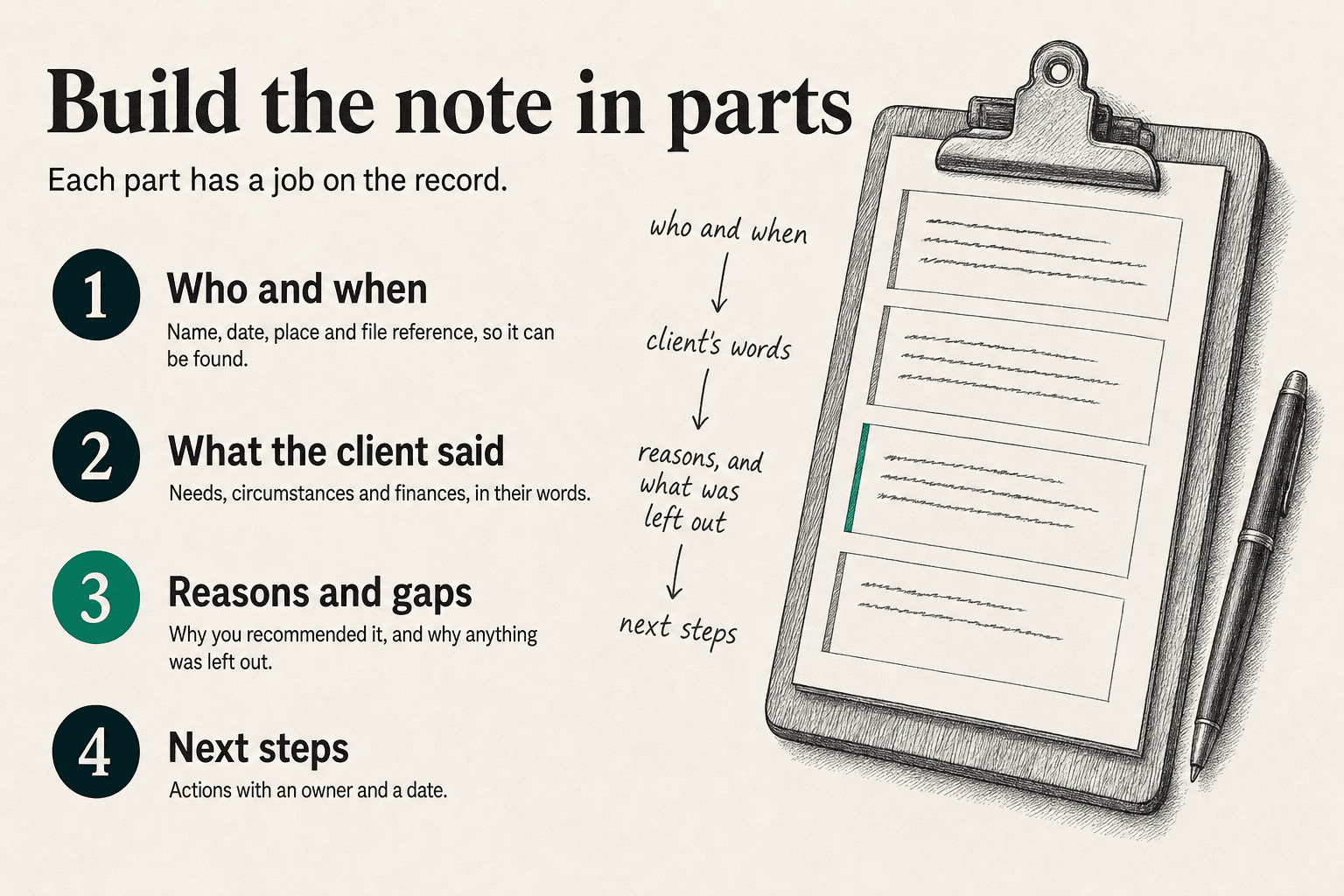
A file note template for Irish advisers: five parts and what each is for
Here is the layout in five parts. It follows the order the Central Bank gives in its General Guidance, which is to gather the information under Regulation 16 and then assess suitability under Regulation 17 (Central Bank of Ireland, September 2026). It is one practical layout, not a form the Regulations prescribe.
- Header: who, when and which file, so the note can be found and dated.
- What the client told you: needs, circumstances, finances, attitude to risk and sustainability preferences, in their words where you can.
- What you discussed and recommended, and why: the reasons, written while the meeting is fresh.
- What was not covered, and why: so a gap reads as a decision.
- Next steps: actions with an owner and a date, and what goes to the client.
Each part below shows the provision behind it.
Header: who, when and which file
The header holds the client's name, the date, the time, the place or channel, who attended, the adviser and a file reference. Regulation 116 says a firm 'shall identify in its records those customers that are consumers' (Central Bank of Ireland, 24 March 2025). Regulation 118(1) says it 'shall maintain complete, orderly, accurate, and readily accessible records' (Irish Statute Book, 24 March 2025). Those two are why the client's name and a findable reference belong at the top.
The time and the channel are our addition, not something either Regulation names. A date and a findable place is what makes everything below it usable.
What the client told you
This part follows Regulation 16(3). The information gathered 'shall include' the consumer's needs and objectives, personal circumstances, financial situation, 'where relevant, attitude to risk', and any sustainability preferences (Irish Statute Book, 24 March 2025). Regulation 16(2) says the detail should be 'appropriate to the nature and complexity of the financial service' sought.
Regulation 16(4) fills in needs, including how long the consumer wants to hold a product and their need for access to funds, emergency funds included. Regulation 16(5) covers circumstances, from age and health to dependents, employment status and known future changes. Financial situation starts with income under 16(6)(a), and the Regulation lists more after that.
Say a client called Aoife wants access to part of her savings within three years. 'Wants flexibility' is a thin line. 'Wants to take out €20,000 within three years for a house deposit, and said she would not tie it up' records the sum, the timeframe and her words.
What you discussed and recommended, and why
Regulation 17(2) says that when assessing suitability the firm 'shall assess and document whether, on the basis of the information gathered' under Regulation 16, the service is suitable (Central Bank of Ireland, 24 March 2025). Regulation 18(3) then has the statement of suitability use that information to 'explain to the consumer how the financial service offered or recommended meets' their situation (same page).
The note is the place to write the reasons down in plain words while the meeting is fresh, including options you considered and set aside. That is our suggestion, not the Regulation's.
What was not covered, and why
Regulation 16(8) limits the lists in Regulation 16, so an item is only required where gathering it is relevant to the suitability assessment (Central Bank of Ireland, 24 March 2025). That leaves a blank space open to two readings. Either the adviser skipped the item, or the adviser decided it did not matter.
A line that says 'not discussed, not relevant to this advice because...' and then gives the reason shows it was a decision. Whether an item is relevant is the adviser's call, and the note shows the call was made. This part is our suggestion, and the Regulation does not ask for the line.
Next steps
This part lists the actions, each with an owner and a date, what goes to the client and when, and the point at which the statement of suitability is signed, dated and given. Regulation 18(1) requires the statement to be prepared, signed and dated before the service is provided or arranged (Central Bank of Ireland, 24 March 2025).
Signatures and dates were what the Central Bank found missing on the KYC and suitability document, so the note is a sensible place to record when the statement was signed and sent.
Putting the file note template to work on the files you already have
Nobody needs a clean-up project for this. The Central Bank's 2024 letter, written under the 2012 Code, said that where gaps are identified in existing files, intermediaries 'must be proactive and use the next engagement/meeting with their customer to update the relevant KYC fact-find and other related documents' (Central Bank of Ireland, 29 May 2024). So the next meeting is the moment to fill a thin part, and the five parts give a quick way to see which one is thin.
The same letter listed good practice it had seen, including 'internal checklists used by firms to ensure all necessary steps taken accompanied with a sign-off by a second person'. The layout can double as that checklist. The second pair of eyes is the Central Bank's example, not our rule.
Say you're three advisers in Galway and your assistant does the files. After each meeting the assistant checks the note against the five parts, flags any that are empty or thin, and the adviser signs off.
We're building Kaitel for this stretch of work. It is a working prototype that we are shaping with Irish practices, around their own documents and processes, aimed at the work after the meeting: the file note, the record and the follow-ups. The idea is to get from meeting to a dated, findable note in one place, and we have no launch date or price to share.
Before you use it: who the rules cover and how long to keep the note
The mapping above is for firms the Consumer Protection Regulations cover. The Central Bank's General Guidance says they apply to investment, insurance and mortgage intermediaries, and that they do not apply to 'MiFID services', other than those excluded from MiFID by Regulation 4(3) of the 2017 Regulations (Central Bank of Ireland, September 2026). The contents list of S.I. 81 of 2025 also shows restricted application for some insurance products and an exemption from knowing the consumer and suitability in some cases (Irish Statute Book, 24 March 2025). A MiFID firm or an insurance-only adviser should check their own position first.
On retention, Regulation 117(1) says firms retain 'any records which detail consumer transactions in respect of its regulated activities for 6 years after the date on which the particular transaction is discontinued or completed'. Where a consumer asked for or was offered a service but did not proceed, Regulation 117(2) says to keep the record for 12 months, subject to the consumer's consent (Central Bank of Ireland, 24 March 2025). Mortgage borrowers may be covered by a separate retention rule, so check this with your compliance support.
Whether a file note counts as a record which details consumer transactions is a reading, and I might be wrong on this. We found no Irish source that names the file note itself. So keep each note with the file it belongs to, findable, and ask your compliance support for the exact period.
An adviser who pulls out the last three notes they wrote and holds them against the five parts will see quickly which part is thinnest. That is the one to fix first. Anyone who wants to be kept posted on the prototype can join the waitlist, where the form is at the foot of the page, and I reply to everyone personally.
The meeting ends. Kaitel gets to work.
Early access · 15 Irish practices in January

James Brooks is the founder of Kaitel. An investment analyst turned founder, he works directly with practising Irish advice firms on the paperwork around the client meeting: fact finds, file notes, suitability letters and follow-ups.